
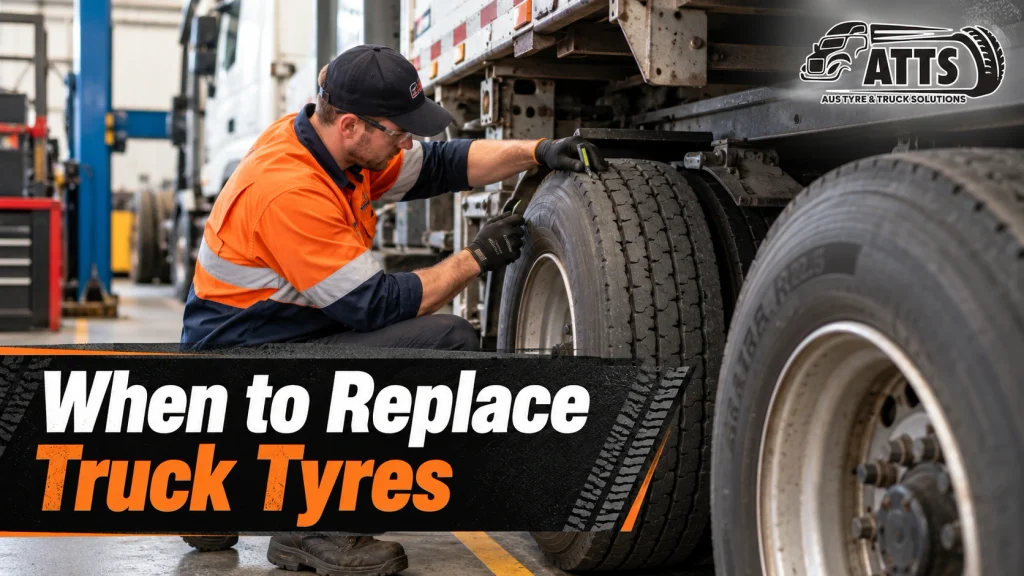
If your truck tyres are showing low tread, cracking, bulges, repeated air loss, or vibration through the steering wheel, it’s time to replace them. Truck tyre life isn’t just about kilometres on the clock. Pressure, load, road conditions, alignment, and general wear all play a part in how long a tyre lasts and how safe it stays.
A tyre should come off the truck the moment it hits the legal wear limit, develops serious damage, keeps losing pressure, wears unevenly, or simply gets too old to trust. Australian heavy vehicle tyres have to meet strict tread depth rules, but a smart operator doesn’t wait until the tyre is legally unroadworthy. If it’s already showing unsafe wear, that’s your cue.
Here are the seven signs every truck driver and fleet manager should be checking for.
7 Warning Signs Your Truck Tyres Need Replacing
Pre-trip and post-trip checks only work if you know what you’re looking at. These are the seven defects that come up again and again during our inspections at ATTS Group, and each one is a genuine reason to book a professional assessment.
1. Low Tyre Tread
Low tread means less grip and poor water evacuation, full stop. Once the tread wears down to flush with the tread wear indicator (TWI) bars, water can’t escape from under the tyre fast enough, and that’s when hydroplaning risk climbs sharply.
Under the Heavy Vehicle National Law, steer tyres need a minimum of 1.6mm tread depth, while drive and trailer axle tyres need at least 1mm. The 20-cent coin test is a quick field check: if the tread doesn’t reach the platypus’s bill, get it looked at. Don’t wait for the legal minimum to arrive before booking a replacement.
2. Uneven Tread Wear
Uneven wear is a symptom, not just a cosmetic issue. Wear concentrated down the centre usually points to over-inflation, while wear on both outer shoulders suggests under-inflation. One-sided wear is almost always an alignment or suspension problem.
Feathered edges (sharp one way, smooth the other) mean toe misalignment. Scalloped, cupped patches point to worn shock absorbers or an out-of-balance wheel. Whatever the cause, if the wear pattern has dropped tread depth below the legal minimum at any single point, the whole tyre is unroadworthy.
3. Cracks or Deep Cuts
Cracks and cuts on the sidewall or shoulder are early warnings of structural weakness. Fine surface lines are usually just ageing rubber and aren’t urgent on their own. Deep cracks or cuts that expose the internal ply, fabric, or steel cord are a different story entirely.
Because the sidewall flexes constantly under load, damage here weakens the whole casing. A sidewall crack deeper than 25mm is generally treated as an automatic fail. These aren’t repairable. Once you see cord or fabric, it’s a replacement job.
4. Bulges or Exposed Cords
A bulge, bubble, or blister on the sidewall means the internal plies have separated. That’s not wear; it’s a structural failure sitting quietly under the surface until it isn’t quiet anymore. Exposed steel cable or fabric cord tells the same story from a different angle.
Truck tyres run at operating pressures up to 120 psi. A structurally compromised casing simply can’t handle that reliably, and the failure mode is usually a sudden, violent blowout rather than a slow deflation. If you spot a bulge, that tyre needs to come off the truck straight away.
5. Frequent Air Loss
A tyre that keeps needing air is telling you something is wrong internally, not just that it’s “a bit low” this week. Commercial tyres naturally lose around 3% of their pressure per month, so anything faster than that points to a slow puncture, a leaking valve stem, or internal damage.
Running under-inflated forces the tyre to flex more than it’s built for, which builds up heat inside the casing. That heat degrades the rubber and the steel belts from the inside out. A tyre that won’t hold pressure needs proper diagnosis, and often replacement, rather than another top-up.
6. Vibration or Poor Handling
Steering wheel vibration, the truck pulling to one side, or a general loss of stability are all signs your tyres need attention now, not next service. These symptoms can come from wheel imbalance or alignment problems, but they often mean uneven wear or internal ply separation.
Don’t assume it’s safe to keep driving and see how it goes. If handling has changed noticeably, pull over and have the tyres inspected. Our team regularly finds this is the first sign fleets notice before a more serious defect shows up on the tread or sidewall, and it’s a good reason to book in wheel alignment services alongside the tyre check.
7. Visible Ageing
Tyres can degrade with age even when the tread still looks fine. Heat, UV exposure, and ozone all oxidise the rubber compound over time, making it harder and less elastic. Look for fine surface cracking, stiff rubber, and a dull or chalky finish, particularly on trailers or spares that sit outdoors for long stretches.
Check the four-digit DOT code on the sidewall for the week and year of manufacture. As a general rule, tyres shouldn’t run past 10 years regardless of tread, and many operators replace steer tyres at the 5 to 7 year mark simply because the consequences of a steer axle failure are so much higher.
What Happens If You Keep Driving on Worn or Damaged Truck Tyres?
Ignoring these warning signs doesn’t just risk a fine. Worn tread means longer stopping distances and reduced wet-weather grip, which is a direct line to a rear-end collision or a jackknife on a wet highway.
The bigger risk is a blowout. At the pressures commercial tyres run, a blowout is violent, and it can pull the whole vehicle toward the failed side before the driver has time to react. Beyond the immediate danger, you’re also looking at:
- Uneven or accelerated wear across the rest of the fleet
- More frequent roadside breakdowns and unplanned downtime
- Roadside defect notices and Chain of Responsibility penalties that follow the vehicle up the supply chain
Truck Tyre Replacement vs Repair: Which Does Your Tyre Need?
Not every damaged tyre needs replacing. A puncture in the tread area, 6mm or smaller, with no surrounding structural damage, can usually be repaired properly using an internal combination patch and plug. Sidewall, shoulder, and bead damage is a different matter and should never be patched.
The safest approach is to have a questionable tyre assessed by someone who inspects tyres for a living, rather than guessing from a quick look.
| Damage Type | Action | Why |
| Puncture ≤ 6mm in tread area | Repair | Safe to patch and plug internally if the sidewall is untouched |
| Sidewall cut, bulge, or crack | Replace | Sidewalls flex constantly and can’t be safely repaired |
| Exposed steel or fabric cord | Replace | Signals casing failure and high blowout risk |
| Tread below legal minimum | Replace | Unroadworthy under HVNL, with longer wet stopping distances |
| Puncture over 6mm or tread separation | Replace | Damage compromises the structural layers of the tyre |
5 Ways to Prevent Premature Truck Tyre Replacement
Good habits stretch tyre life and cut cost per kilometre. None of these takes long, and all of them pay for themselves.
- Check pressure weekly, when cold, using a calibrated gauge rather than guesswork
- Watch for uneven wear early, before it eats into tread depth on one section of the tyre
- Keep wheels properly aligned, ideally checked every 10,000km or six months
- Avoid overloading axles, since excess weight accelerates wear and heat build-up
- Match the tyre to the application, whether that’s long-haul highway work or mixed on/off-road use
Catching a pressure, alignment, or wear issue early is almost always cheaper than the replacement that follows if it’s left alone.
Get Truck Tyre Replacement Support From ATTS Group
At ATTS Group, we inspect, assess, and replace truck tyres for fleets and owner-operators across Perth every week, and we’d rather flag a problem early than deal with a breakdown on the side of the road.
Whether you need a straightforward tread check, a full truck tyre supply and fitting service, or ongoing fleet tyre management to stay ahead of these warning signs, our Kenwick-based team can get your vehicle assessed and back on the road without unnecessary downtime.
FAQs
How often should truck tyres be replaced in Australia?
Most truck tyres last 5 to 7 years or 40,000 to 100,000km depending on use, but condition matters more than age or mileage alone.
Can a truck tyre with a sidewall bulge still be driven?
No. A sidewall bulge means internal ply separation and can cause a sudden blowout. Have the tyre replaced before the truck goes back on the road.
Does tyre brand or retread affect how soon replacement is needed?
Yes. Retreaded casings and budget tyres often show wear or damage sooner than premium new tyres, especially under heavy highway loads.
Can uneven truck tyre wear be fixed without replacing the tyre?
Sometimes. Correcting alignment or pressure early can stop further damage, but tyres already worn past the legal limit still need replacing.